
.png) 1 month ago
42
1 month ago
42
ARTICLE AD BOX
The Super Eagles’ failure to qualify for the 2026 FIFA World Cup was another painful reminder that talent alone does not guarantee success, Afrik Foot reports.
However, under Coach Eric Chelle, there are promising signs. The recent friendlies against Poland and Portugal, alongside the 2026 Unity Cup success, gave glimpses of a rebuild as younger players stepped up.
By 2030, the Super Eagles could look very different. Several current regular faces will most likely be phased out, while the younger generation will be expected to carry Nigeria back to the biggest stage.
Should the Franco-Malian tactician remain Nigeria’s coach in 2030, and retain his 4-3-1-2 system, Afrik Foot highlights what Nigeria’s starting XI could realistically look like in four years.
/https%3A%2F%2Fmedia.afrik-foot.com%2Fen-ng%2F2026%2F06%2Fimago1071292744-1.jpg) Super Eagles. Copyright: xshengolpixsxImago
Super Eagles. Copyright: xshengolpixsxImagoSuper Eagles’ potential starting XI in four years
Goalkeeper: Arthur Okonkwo
The goalkeeping spot in the Nigerian National team still feels pretty much open, but in four years, Arthur Okonkwo has the potential to make the position his.
By 2030, the AFC Wrexham goalkeeper will be 28. His physical profile, composure under pressure, and ability with the ball at his feet fit the modern game.
/https%3A%2F%2Fmedia.afrik-foot.com%2Fen-ng%2F2026%2F04%2Fimago1075445955-1.jpg) New Super Eagles and Wrexham AFC goalkeeper Arthur Okonkwo. Copyright: ImagoxMIxNewsx
New Super Eagles and Wrexham AFC goalkeeper Arthur Okonkwo. Copyright: ImagoxMIxNewsxNigeria have rotated between Stanley Nwabali and Maduka Okoye in recent years, but Okonkwo feels like the future.
However, to make the spot his own, he’d have to be properly vetted and tested across several games in the Green and White jersey, not just for his ability, but also for his mental fortitude when things don’t go his way.
If he continues developing, the shirt could be his for the next decade.
Right-back: Abdullahi Bewene
The Banik Ostrava defender only just broke into the Super Eagles setup due to Femi Azeez’s absence for the friendlies against Poland and Portugal.
/https%3A%2F%2Fmedia.afrik-foot.com%2Fen-ng%2F2026%2F06%2Fimago1078166925.jpg) Super Eagles debutant Abdullahi Bewene, vs Poland. Copyright: xAndrzejxIwanczukx IMAGO
Super Eagles debutant Abdullahi Bewene, vs Poland. Copyright: xAndrzejxIwanczukx IMAGOStill, his early performances have been encouraging. He fit in right with the established members of the team, attacked when needed and showed grit at the back, getting stuck in against both European teams.
By 2030, he will be 25, just entering his prime. The competitors like Ola Aina, Bright Osayi-Samuel will be well into their 30’s, and for a position that thrives on athleticism, young legs are usually preferred.
Centre-back: Benjamin Fredrick
The Brentford centre-back was slotted into Nigeria’s starting eleven during the 2026 FIFA World Cup qualifiers, displacing the experienced William Troost-Ekong at the heart of the Super Eagles’ defence.
/https%3A%2F%2Fmedia.afrik-foot.com%2Fen-ng%2F2026%2F06%2Fimago1062620829.jpg) Benjamin Fredrick during the Unity Cup Final. Copyright: ImagoxToyinxOshodix
Benjamin Fredrick during the Unity Cup Final. Copyright: ImagoxToyinxOshodix Under Eric Chelle, Fredrick is the first choice, alongside Calvin Bassey, and a knee injury stopped him from having an AFCON 2025 campaign that would’ve made that spot his for the next decade.
Semi Ajayi is already 32, and it is only a matter of time before Fredrick claims the position occupied by the Hull City defender. In four years, the young centre-back will be 25.
Centre-back: Calvin Bassey
Bassey will be 30 by the next World Cup and will be the leader of Nigeria’s defence, if not the captain of the team.
His strength, athleticism, ability to recover in transitions, and comfort playing out from the back make him irreplaceable.
/https%3A%2F%2Fmedia.afrik-foot.com%2Fen-ng%2F2026%2F06%2Fimago1071276030-1.jpg) Super Eagles defender Calvin Bassey. Copyright: xshengolpixsxIMAGO
Super Eagles defender Calvin Bassey. Copyright: xshengolpixsxIMAGOAway from his abilities on the pitch, his leadership will also be vital in the dressing room, as he’ll be the perfect figure for the younger players to learn from.
Left-back: Bruno Onyemaechi
This position remains one of Nigeria’s least settled, but Onyemaechi currently has the edge over Zaidu Sanusi.
He would be 31 in 2030, bringing experience and leadership to the backline alongside Bassey.
/https%3A%2F%2Fmedia.afrik-foot.com%2Fen-ng%2F2026%2F04%2Fimago1070835939.jpg) Onyemaechi Bruno, Ogbu Igoh and Moses Simon. Copyright: xVincentxKAMTOxIMAGO
Onyemaechi Bruno, Ogbu Igoh and Moses Simon. Copyright: xVincentxKAMTOxIMAGOUnless a younger left-back emerges quickly, no predictable circumstance sees Onyeamechi displaced in that position.
Defensive midfield: Raphael Onyedika
Every strong team needs an anchor, and with Ndidi set to turn thirty in December, there’s need for a worthy replacement.
Club Brugge’s Raphael Onyedika looks built for that role, although his strengths lie in less physical setups.
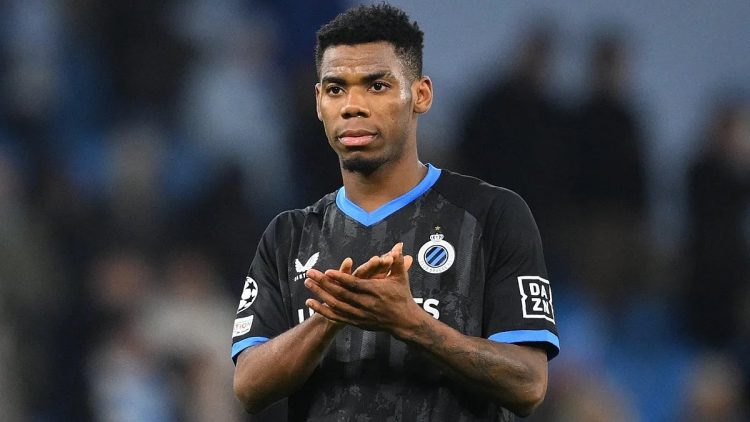
/https%3A%2F%2Fmedia.afrik-foot.com%2Fen-ng%2F2026%2F02%2Fimago1072823020.jpg) Raphael Onyedika of Club Brugge. Copyright: ImagoxVincentxKalutx
Raphael Onyedika of Club Brugge. Copyright: ImagoxVincentxKalutxBy 2030, he will be 29 and should have perfected the art of ball-winning, tactical discipline, and the ability to shield the defence, becoming the core foundation of this midfield diamond.
Central midfield: Ebenezer Akinsanmiro
Akinsanmiro has long been viewed as one of Nigeria’s brightest midfield prospects.
While he’s yet to have a run on games with the Super Eagles, the former Inter Milan midfielder has shown that he’s technically gifted and a relentless runner with his club side Pisa, making him the perfect profile to take over from Frank Onyeka.
/https%3A%2F%2Fmedia.afrik-foot.com%2Fen-ng%2F2026%2F05%2Fimago1076347620.jpg) Ebenezer Akinsanmiro. Copyright: Imago
Ebenezer Akinsanmiro. Copyright: ImagoBy 2030, Akinsanmiro will be 26, more mature, and will definitely be a key player for the three-time AFCON winners.
Central midfield: Fisayo Dele-Bashiru
Dele-Bashiru’s profile makes him the perfect attacking eight or hybrid ten.
Powerful, direct, and capable of arriving late into the box, he offers goals from midfield, something Nigeria have lacked for years.
/https%3A%2F%2Fmedia.afrik-foot.com%2Fen-ng%2F2026%2F06%2Fimago1078333389.jpg) Nigeria and Lazio star Fisayo Dele-Bashiru. Copyright: xMikolajxBarbanellxIMAGO
Nigeria and Lazio star Fisayo Dele-Bashiru. Copyright: xMikolajxBarbanellxIMAGOHe’ll be practically replacing the beloved Alex Iwobi in Nigeria’s starting lineup, and while he’ll be 29 in 2030, the former Manchester City midfielder has to work on his passing to become the bridge between midfield and attack.
Top of the diamond: Femi Azeez
A wildcard, but one with huge upside. Azeez’s creativity, dribbling, and unpredictability could make him the natural link between midfield and the front two.
This role demands intelligence and quick decision-making, and in two games at the Unity Cup, the Millwall winger shows he has what it takes to make the position his own.
/https%3A%2F%2Fmedia.afrik-foot.com%2Fen-ng%2F2026%2F05%2Fimago1077916231.jpg) Super Eagles star Femi Azeez celebrates. Copyright: xToyinxOshodixIMAGO
Super Eagles star Femi Azeez celebrates. Copyright: xToyinxOshodixIMAGOBy 2030, the England-born Nigerian will be 28, looking to feed the strikers up front like Ademola Lookman did at the AFCON 2025 tournament.
Striker: Victor Osimhen
Without a doubt, the former Napoli striker will still be the undisputed face of Nigerian football.
By 2030, Osimhen will be 31, and only very few strikers have slowed down at that age. The likes of Cristiano Ronaldo and Karim Benzema hit individual highs after crossing the 30-year mark.
/https%3A%2F%2Fmedia.afrik-foot.com%2Fen-ng%2F2026%2F05%2Fimago1077369410.jpg) Victor Osimhen of Galatasaray. Copyright: ImagoxSeskimphotox GSaray
Victor Osimhen of Galatasaray. Copyright: ImagoxSeskimphotox GSarayWhile his pressing rate might not be the same anymore, his goal sense will get even better.
Unless injuries intervene, this is still his team.
Striker: Kparobo Arierhi
The Lillestrom gem could be Nigeria’s next breakout striker. Kparobo Arierhi has already built a reputation as one of the biggest Nigerian youth names.
His finishing instincts, physicality, and hunger make him an ideal long-term partner for Osimhen.
/https%3A%2F%2Fmedia.afrik-foot.com%2Fen-ng%2F2026%2F06%2Fimago1076966939.jpg) Lillestrom’s Kparobo Arierhi. Copyright: ImagoxBeatexOmaxDahlex/xNTBx
Lillestrom’s Kparobo Arierhi. Copyright: ImagoxBeatexOmaxDahlex/xNTBxBy 2030, he will be 23, and if developed correctly, could be Nigeria’s next big striker after Osimhen.
/https%3A%2F%2Fmedia.afrik-foot.com%2Fen-ng%2F2026%2F06%2Fimago1077369648.jpg)
 English (US) ·