
.png) 2 months ago
50
2 months ago
50
ARTICLE AD BOX
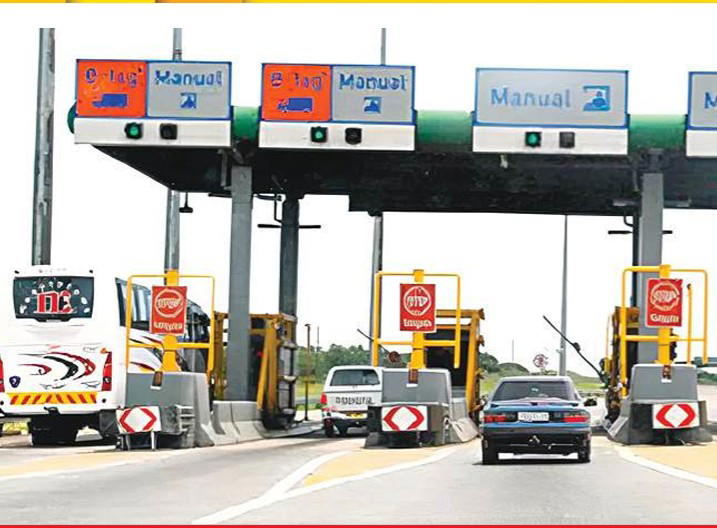
•Human trafficking thrives, drivers allege extortion •Immigration denies operating roadblock •Allegations must be proved —FRSC •We have only two checkpoints along road — Customs •Police defend huge deployment of officers on route
By Efe Onodjae
On May 25, 2026, the Seme Area Command of the Nigeria Customs Service invited this reporter to a press briefing.
It was my first visit to the command since my deployment to the Maritime Desk.
To attend the briefing, I boarded a commercial bus from Mile 2 in Lagos State to Badagry Roundabout at exactly 9:36 a.m.
The road was initially free, but traffic gradually built up along the route.
At Agbara, I encountered the first checkpoint jointly operated by officers of the Nigeria Customs Service and the Nigeria Immigration Service.
Their presence was unmistakable, with the agencies’ names boldly inscribed on their tents.
I eventually arrived at Badagry Roundabout around noon, where I met a friend, Manoah Kikekon, a Badagry indigene who runs a blog and is familiar with the Seme border route.
I invited him to accompany me to the briefing.
I initially suggested taking a tricycle, but he objected, insisting that motorcycles were faster because security operatives manning checkpoints along the route rarely stopped bike riders. He said, “Let’s take a bike. The checkpoints on the road barely disturb bike riders, so our journey will be faster. If we take a tricycle, we could spend hours on the road. “As you go, count the number of checkpoints so you can see what I have been telling you about this route.”
To begin the journey, we paid N3,000 to a commercial motorcycle rider.
As we travelled, we encountered multiple checkpoints manned by officers in different uniforms — Customs, Police, Federal Road Safety Corps (FRSC), Immigration, Civil Defence, and the military.
I also observed commercial drivers being repeatedly stopped from one checkpoint to another.
Despite using a motorcycle, we arrived at the venue around 2 p.m., long after the briefing had ended.
I was only handed the press statement earlier read by the Customs Area Controller.
Smuggling Routes Shift to Villages
Having heard stories about smuggling activities along the route, I was curious to understand how such operations continued despite the heavy security presence.
I questioned my friend, who explained that smugglers no longer relied on the major highway.
He said, “Those smuggling rice into the country now use alternative routes through villages to avoid security officers.”
He later took me to a village identified as Adesungbeme/Azangbeme in Babapupa, Badagry West LCDA.
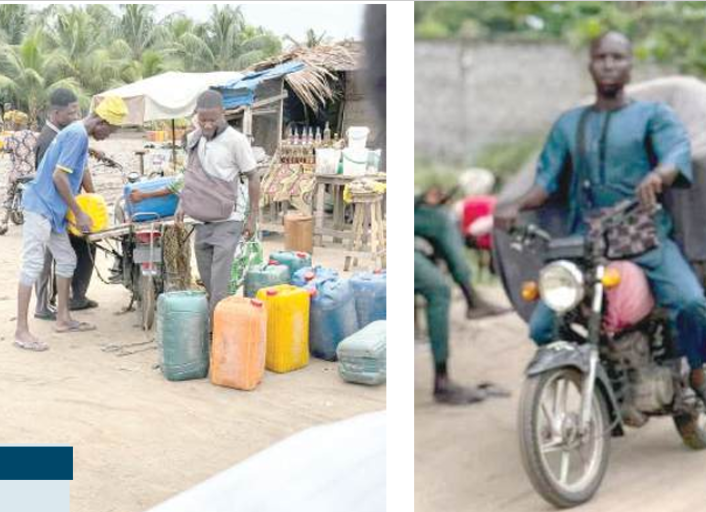
According to him, the village serves as an alternative route used by smugglers moving petrol into a border community in Seme known as Pawu.
At the village, I observed motorcycles transporting petrol from Nigeria into Seme.
I also witnessed a woman transferring fuel from kegs into sacks.
Residents who spoke with this reporter claimed that while petrol is smuggled during the daytime, rice smuggling and human trafficking activities mostly take place at night.
One motorcycle rider in Pawu, who requested anonymity, said, “I don’t operate during the daytime. Some of us only move at night, carrying rice from Pawu to Nigeria. “Sometimes, I also carry young ladies. I don’t know who they are, but they usually say they are going to meet relatives in Seme. I only do my job.”
The village appeared largely underdeveloped, with no visible electricity supply.
According to Kikekon, the Babapupa route has also long been identified as a major corridor for human traffickers and irregular migrants.
Counting Checkpoints
After spending time speaking with residents and motorcycle riders, my friend and I boarded a commercial vehicle back to Badagry Roundabout, this time determined to count the checkpoints along the route.
From the Seme border to Badagry Roundabout, we counted 60 checkpoints.
At virtually every checkpoint, the driver of the vehicle we boarded was stopped and asked to pay N200.
Among the checkpoints counted were 12 operated by Customs officers, 27 by the Police, four by Immigration officers, five by the FRSC, five by the military, and two by the National Drug Law Enforcement Agency (NDLEA).
Drivers Decry Extortion
At Badagry Roundabout, I spoke with commercial drivers who expressed frustration over what they described as persistent extortion along the route.
One union member alleged that transport operators charge N2,000 per passenger from Badagry to Seme and usually carry six passengers per trip.
According to him, the numerous checkpoints consume most of their earnings.
“We operate on this route, and there are about 67 checkpoints from Badagry Roundabout to Seme,” he said.
“At each checkpoint, officials collect money from us. Out of the checkpoints, there are Police, Customs, Immigration, Civil Defence, Army, and Road Safety officers.
“Road Safety officials stop us regularly. Even after paying money at their camp, officers still demand more on the road.
“Passengers pay N2,000 each from Badagry to Seme, but most of the money goes into settling officers at checkpoints. We are living in a lawless country.”
Official Checkpoints
However, according to Kikekon, during a stakeholders’ meeting held last year, former Seme Area Comptroller, Wale Adenuga, reportedly stated that only two recognised Customs checkpoints exist between Lagos and the Seme border, the Agbara checkpoint and the Gbaji Bridge checkpoint.
The statement was captured in a voice recording later played to this reporter.
He explained that the former Comptroller was particularly strict about illegal checkpoints on the Seme Road.
His words, “Wale Adenuga was very harsh on illegal checkpoints. In 2025, he held a stakeholders’ meeting with many of us, during which he stated categorically that only certain checkpoints on the road were officially recognised.
“In fact, he was the one who demolished the Oloko checkpoint, where a structure had been built. He destroyed it.
“Most of these officers have since relocated to the Owode-Apa Road, which also leads to the border.
“I must say that the presence of multiple checkpoints is discouraging tourism in Nigeria.”
According to a resident of Seme simply known as Bienvenue, fuel is difficult to get in the area, thus making the product more expensive than it is in Nigeria.
He added that, in Benin Republic, a liter of petrol costs 700Cf which translates to N1,800.
Immigration Reacts
When contacted, the spokesperson for the Nigeria Immigration Service at the Seme Border Command denied responsibility for the checkpoints.
He said, “I am the Public Relations Officer of the Nigeria Immigration Service, Seme Border Command, not the Lagos Border Patrol Command. My command does not have a single checkpoint on the road.”
Also when contacted, the spokesperson for the Lagos State Police Command, SP Abimbola Adebisi, in a text message, wrote: “The Badagry–Seme corridor is an international border axis and, as you know, enhanced security presence and visibility along such routes are critical to preventing cross-border crimes and other unforeseen security threats.
“The deployment of police personnel and other security agencies in the area is therefore aimed at safeguarding lives and property and ensuring the security of the border communities and the state at large.
“However, all police officers deployed for operational duties are expected to conduct themselves professionally, courteously, and in strict compliance with the ethics and standards of the Nigeria Police Force. The Commissioner of Police, Lagos State Command, CP Fatai Tijani, PSC, MNIPS, does not and will not take with levity any act of unprofessional conduct, extortion, or misconduct by any police personnel.
“Please next time, kindly stylishly get me some details of any of the officers so the command can take necessary action. “Meanwhile this will be taken up with the Area Commander”.
When contacted, the Sector Commander of the Federal Road Safety Corps (FRSC) in Lagos, Corps Commander Kehinde Hamzat for his part, explained that the number of deployments of officers on the road cannot be ascertained.
He said, “Any allegation must be substantiated before we can take action. As the Lagos State Sector Commander, I can only act based on credible evidence.
“If there are specific names and evidence, then, of course, any staff involved should know that they are heading for trouble. But without such evidence, it becomes difficult to establish the facts.
“In cases of corruption, both the giver and the receiver are culpable. During the course of your investigation, I hope you can obtain details of the officer who allegedly collected the money and, if possible, the registration number of the vehicle from which it was collected.
“Technology has provided us with opportunities, the opportunity to record incidents and gather evidence. Once we have such details, we can take it from there.”
Speaking on the number of officers expected to be on the road, he said; “I am not in a position to answer that directly because I have a unit there.
“The Unit Commander in Badagry is responsible for making the necessary deployments to locations he considers flashpoints, but certainly not with the intention of extorting members of the public.”
The spokesperson for the Seme Area Command of the Nigeria Customs Service, Superintendent of Customs (SC) Ayagbalo Tunde, when contacted, maintained that there are only legal Customs checkpoints along the road.
His words: “The Seme Area Command officially maintains two Customs checkpoints along the Lagos-Abidjan corridor, one at Gbaji and the other at Agbara Bridge.
“These are the only designated points. Furthermore, Section 226 of the Nigeria Customs Service Act 2023 empowers officers of the Service to patrol freely and have access to any part of Nigeria, including coastal and inland waterways, without being liable for trespass.
“The other locations you observed are not ‘checkpoints’ in the legal sense. They are patrol bases/outposts strategically positioned to enable rapid response to actionable intelligence.
“Their purpose is to enhance anti-smuggling operations and intercept economic saboteurs.
“Lastly, the leadership of the Seme Area Command under Comptroller A.S. Kaila operates a zero-tolerance policy on extortion and any form of unprofessional conduct.
“Any officer found collecting money illegally at any point, whether at a checkpoint or patrol base, will be identified, investigated, and dealt with in line with extant rules and the NCS Act 2023.
“We urge you and other road users to report any such incident immediately to the Command’s help desk with details of time, location, and vehicle particulars for prompt action.”
Also reacting, Mr. Osteen Nwosu, Secretary of the Association of Nigerian Licensed Customs Agents, ANLCA, Seme Chapter, appeared to corroborate Tunde’s claims, saying the 12 checkpoints identified along the corridor does not belong entirely to the Customs Service.
Nwosu disclosed that there are only two officially recognised checkpoints by the Seme Border Command of the NCS.
He said: “The Seme Area Command operates only two official checkpoints on the axis — one at Gbaji and another at Agbara.
“The two additional checkpoints are the Seme roving team and the Federal Operations Unit (FOU) of the NCS”.
The ANLCA leader further clarified that the roving team is not stationed at any fixed location but operates on a mobile basis, stopping at strategic points whenever suspicious human or vehicular movements are observed because they have a strategic base where they pull out on information patrol or operations
He also said that the FRSC has just one checkpoint in front of their office.
Nwosu’s words: “I cannot speak for the Police and other security agencies but the Customs and FRSC, the numbers of checkpoints are exaggerated.
“The former Area Comptroller of the Customs, Mr. Wale Adenuga, was able to prune the number of checkpoints to as low as two.”
The post Border corridor: Petrol freely smuggled out, rice is smuggled in despite 60 checkpoints appeared first on Vanguard News.





 English (US) ·